iPhone and the essence of computer games

I’ve stuffed my iPhone with several games that remind me of the “classics” I used to play as a kid. I am not referring to just emulators but also games developed just for iPhone.

iCopter – pictured above – is a great example. A straightforward game where you try to keep a helicopter flying forward with single taps on the screen. What makes this game addictive is the quick cycle: typically you will be dead in less than 30 secs and even the best runs take less than a minute. It’s so tempting to try again! My record so far is 546 1263 points (game version 0.1). Can you fly further than that?

How much 3G exactly eats your battery?

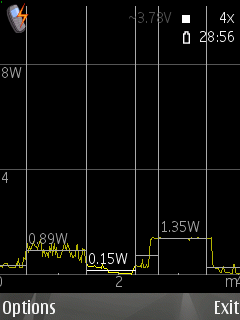
The pic above, taken from Nokia Energy Profiler shows first a short GSM call taking 0.9W and then a similar 3G call taking 1.35W in Helsinki city centre. In other words, a huge difference. My friend Mika who was in charge developing that particular app reports that a standard battery that would last 3 hours with 3G would last as much as 4h 45min with GSM! That’s also the main reason why my iPhone is running GSM – and I’m quite ok with that. Greenies will also conclude that 3G is not good for the environment…

Why commodity computing is a socialist fad

Some two days ago I started to read Nick Carr’s (an American IT-guru of “IT doesn’t matter” -fame) article on FT. It’s excerpt from his new book Big Switch. I guess you don’t have to buy the book to get his argument. It was actually already present in IT doesn’t matter: the commodification of computing and especially software.

The argument is not new and I have never understood it. The first time I saw it was maybe in early 1991 when I received the first subscribed copy of Tietokone-magazine, the local computer magazine aimed at PC enthusiasts and professionals. On the cover there was a bunch of monitors and keyboards but the central units were notoriously missing. The claim was that this is the future of computing. WTF?! These fucking dumb “clients”?! I remember I almost canceled my order right away. I just knew that this claim was so wrong. And even if it would have been to the right direction I definitely hoped that this bad omen would never materialize.

But now we are at it again, just in a bit different form. I did have problems with Carr before but now that I read his latest work I understood he’s just another John Dvorak. Carr’s problem are analogies that sound nice but do not work in practice at all. His most prominent analogy is to compare software with electricity. Yeah, hundred years ago or so electricity became commodity. Some companies disappeared. And – Carr says – the same is now happening to software. Microsoft is disappearing. Software is becoming commodity like Gmail and Gaps, or whatever they are called. Right?

I say Carr mixes up the Internet with software applications without understanding their basic differences. Internet is commodity, correct. It’s like public roads. But most software applications are not commodity. My software applications are like my car, they are stand-alone engines fed by my over-powered personal computer. I don’t use Google’s apps, and I won’t. I know this is costing the society resources but so are all those millions private cars not running at the moment (or run by just the driver). I’m not taking collective traffic because it simply does not deliver. End of argument. Socialism failed, and so did Nick Carr.

Why I had to open it again!

Quick answer: I will not configure the Windows hell-house. Period.

My wife’s Windows XP laptop apparently does not understand Airport Extreme’s WPA security or something. It shows outside like an open network while it needs a password and I’m pretty sure of it. I spent almost an hour for this shit. I’m done with Windows, hopefully forever. That collection of carbage supposedly used by over 90% of average end-users has worse config screens (that are all needed, by the way) than your typical open source hack for system admins. You know those inexplainable options with never-heard-before acronyms and impossible-to-guess ten-click paths to the screen you are looking for. Your standard method for getting anything to work in Windows is not plug-and-play but trial-and-error. Trial and error! Repeated until you start to think there must be something wrong with you while in fact it’s always the so-called operating system and its failed design.

This is what you get when engineers are designing things for engineers. Like Nokia phones these days. Inhuman. Disgusting.

So it’s the free ether again. And let’s hope the leechers won’t force me to try any Windows config attempts ever again.